How
To Protect and Clean
Your Car Paint & Bodywork
Share This If You Like It:
CLEANER: A cleaning agent may be either friction or chemical. A friction cleaner is usually either a silicate or clay particulate. If you examine your paint through a microscope, it would look like a mountain range with peaks and valleys. The friction or abrasive (don't get nervous at the word abrasive) type cleaner will clip the tops of these mountains off and help fill in the valleys, to approach the optimum smooth plane that offers the greatest depth of shine. Friction cleaners are usually described as fine, medium or heavy cut. When in doubt, use the least aggressive product. A chemical cleaner will usually strip equal amounts of hill and dale and thus not help smooth the paint. A cleaner should also remove old wax and other contaminants in the paint. Chemical type cleaners are usually more effective in removing the remains of 100 M.P.H. bugs, stains, tree sap and tars. Avoid silicone-based products as they are not beneficial to paint and can cause problems down the road. Ask any professional car painter their thoughts on silicone products, and you will usually get a 30-minute tirade. GLAZE: A glaze usually denotes a superfine friction type of cleaning agent, usually with essential emollients and lubricating oils and may even contain some mild chemical cleaners. Glazes will usually remove mild swirl marks, scratches, refresh the paint with oils and smooth out the finish. POLISH: A polish is normally a non-abrasive product based on a nutrient oil matrix and may or may not have a chemical cleaner as part of the package. Most polishes use fillers to help cover swirl marks. COMPOUND: A compound is the "coarse sandpaper" of the paint-cleaning world. This should be used only if the paint is in serious trouble and all else has failed. If you are one step away from 1-800-NEW-PAINT, then you may consider a compound. CLAY: Literally a plasticene/abrasive mixture used to smooth new paint and remove over spray. This type of product must be used with lots of lubricant. The technique of using a clay is a learned skill. Use too little lubricant, or get contaminants in the clay, and you have moved into scratch city. This is one product that is the fast lane to trouble if not used with extreme care. Note: Clay is NOT damaging if you use a light grade. Clay is also suitable for old paint and does not remove a layer of paint. It removes contaminants from the paint. Any amateur using reasonable care can buy a Meguiars or Mothers light Clay Bar kit and successfully use it on a vehicle without damaging anything.
WAX: There are two broad categories of wax, organic and polymer based. The organic waxes may be derived from plants such as Carnauba, or varmints, such as bee's wax or some of the K-Mart specials contain paraffin refined from dead dinosaurs. The polymer-based waxes are usually collected from specially trained robotic bees that gather the polymer nectar from plastic flowers (or it may be made in chemical factories). Share This If You Like It: DEGREASERS/TAR/BUG REMOVERS: These types of products are normally solvents designed to dissolve surface contaminants such as road tar or bugs. There are two broad classifications of solvents, petroleum distillates and citrus based. The quality citrus products tend to be gentler on the paint. Any degreaser/tar/bug remover will remove wax. So after you have rid your car of the remains of Billy bee, you will have to rewax the area. (What is the last thing that goes through a bee's mind as he slams into your windshield at 60 mph? ......His stinger.) Be aware that many of the popular over the counter tar removers are based on kerosene and may cause long-term damage to paint. How Often Should You Clean? How often should you clean the paint? The correct answer is based upon several factors.
If the finish is subjected to acid rain, and the effects of highly acidic bird offerings, then you may have to clean specific areas of the finish a little more often. If someone tells you to clean the paint each time you wax, then they are either trying to sell you another paint job or have an excess of cleaner they are trying to unload. Power tools and fine finishes, in my humble opinion, do not mix. The advantage of power is speed. This also applies to getting yourself into trouble. The edges of your body panels and raised/creased areas of the sheet metal have the thinnest layer of paint. When the body is painted, the liquid paint will tend to flow away from these raised areas. A power buffer will concentrate its energy on the thin paint of these high points. This is another way of saying hello to your primer or as the professionals say, "burning an edge". However, a rotary or dual orbital (depending on task) machine is essential for compounding paintwork, and the cutting/compounding/polishing/jewelling action of a good machine (such as a Cyclo, Festool, PC, Makita or Rupes) and selection of pads is essential to achieving a swirl-free, RIDS-free, hologram-free, wet look finish. If you use a power buffer, use only closed cell foam pads and use one pad for each product. Do not use lambs wool type of pads, as they are swirl marks waiting to happen. Most importantly, use only a cleaner/glaze/polish type product that is specifically formulated for use with a power buffer. The frictional heat of a buffer will cause some product's abrasives to flocculate or clump together and make your hood look like a newly plowed cornfield. Most people do not appreciate this look. I have defined some of the major types of cleaners, but realize that the numberless manufacturers do not all conform to the defined nomenclature. I personally prefer a glaze to a polish to clean and prepare the paint for wax. The difference is that a glaze uses a superfine abrasive cleaning agent, whereas a polish usually uses a chemical cleaner. The glazes tend to smooth out the paint more effectively than the polishes. If the paint does not have any imperfections, then a polish should be enough. As a rule, if you have swirls or light scratches, then use a glaze. If you don't then use a polish. The first step to your cleaning/waxing regimen is to wash your car with a quality car wash and dry thoroughly. The benefits of a clean surface cannot be over emphasized, unless you are a fan of swirl marks and feel that hairline scratches are attractive, wash thoroughly before starting.
Pick a section of the car such as the hood, door, top or whatever. Glaze/polish this section of your car completely, redoing any section(s) that need additional help. The glaze/polish should produce the deep gloss that you desire. Once this section dazzles you with it's brilliance, then and only then, apply a coat of wax to this section. Realize that the wax is nothing more than a clear protectant and will not remove or hide scratches or swirl marks. Once this section of your car has been completed, move onto another section and begin the glaze/polish and wax process again. If your paint has swirl marks, acid rain marks or faint scratches, then you may wish to use a glaze. The definition of a faint scratch is one that you can see but not feel. If you can feel the scratch with your fingernail, then it is beyond the scope of this article and should be treated as a paint chip. Rule #1: Use the least aggressive product/technique to get the job done! It is very easy to repeat an application of a mild product to achieve a result, but is very expensive to replace paint when you have gotten too aggressive. If your paint does not have swirl marks/scratches, but has lost some of it's luster, then you may consider using a polish. I usually prefer glazes to polishes, but that is somewhat subjective and very dependent upon the condition of the finish.
Any cloths you use on your car should be 100% cotton or Microfibre products
and should be washed in the washing machine using only detergent. Do not add any
fabric softener to the water. Dry them in the dryer and DO NOT use a dryer anti-static
towel (I think that's what they are called). These dryer towels contain coatings
that are transferred to your car cloths and may cause streaks. If you have ever
had your wax streak and you could not figure out why, your dryer towel was probably
the culprit. You will remove a giant ball of cloths and static electricity from
your dryer, but will not have mysterious streaks.
Buff out a small section, shake out the cloth (away from the car) to remove any grit and rebuff with a new section. Keep using new sections of cloth and change cloths frequently. I use my wife's old flannel sheets. They are super soft and produce a brilliant shine. (Try not "borrowing" the sheets from the marital bed, as this may lead to some spousal discontent.) When the chosen section of the car has been completed, rebuff with another clean cloth. If you are happy with the shine and deep gloss of the section, apply a coat of your favorite wax. Paint Cleaning Agents - Review I have outlined the types and usage of glazes and polishes, now I will list several quality paint cleaning agents and give a brief synopsis of each. The most important caveat is "use the least aggressive product to accomplish the task". It is easy to redo an area with a gentle product; it is rather costly to replace paint once you have gotten enthusiastic with a very aggressive product. The list is alphabetical, so infer nothing by the order. You may read between the lines to determine my personal favorites.
3M IMPERIAL HAND GLAZE: This is my personal favorite (how is that for between the lines?). I have tried just about every product on the market, and keep coming back to 3M Hand Glaze. It is gentle on the paint, produces, in my humble opinion, the deepest gloss, yet is aggressive enough to remove fine swirl marks and scratches. It also "feeds" the paint with emollient oils. If an area needs a little more aggressive cleaning, soak your pad in the 3M and add a small amount (about the size of your pinkie nail) of P21S Multi Finish Restorer Polish (don't you just love the translation of German names?), mix the two together on the pad and then rub out the area using a linear motion. Buff out and repeat if necessary. This combo works very well on swirl marks and scratches that can be seen but not detected with your fingernail. Once the blemish has been removed, follow with an application of straight Hand Glaze to restore the deep shine and then wax. The recess behind the door handles is a classic area that responds well to this combination. HARLY PRE-WAX CLEANER: A mild chemical cleaner and polish that does a decent job on oxidized paint, but doesn't remove scratches that well. It does work very well on oxidized chrome.
MEGUIAR #02 FINE CUT CLEANER: A mildly abrasive cleaner for fine swirl marks, water spots, and fine defects. Follow with a fine glaze and a coat of wax. The "fine sandpaper" in the abrasive cleaner family. MEGUIAR #04 HEAVY CUT CLEANER: A heavy-duty abrasive cleaner for paint that is one step away for 1-800-NEW-PAINT. This is slightly safer to use than compounds. Should be followed by an application of #02 and then a fine glaze and a coat of wax. Use with extreme care, or you will make some body shop person very happy. MEGUIAR #06 CLEANER/WAX: A one step chemical cleaner with a liquid wax. Use for spot application when your favorite cleaning/wax regimen is not practical, or use on your Yugo. MEGUIAR #07 SHOWCAR GLAZE: A hand applied glaze to remove fine swirls and water spots also adds emollient oils back into the paint. Follow with a coat of quality wax. MEGUIAR #09 SWIRL REMOVER: This is a polish (chemical cleaner with an emollient oil matrix) that works well on clear coat finishes that are in reasonably good shape. MEGUIAR MEDALLION PAINT CLEANER: Another chemical cleaner that contains a fair amount of polymers. This may not work well with some German finishes. Designed for use with the Medallion cationic bonding system. ONE
GRAND CLEAN & WAX: A one step chemical cleaner, filler and liquid wax.
Will hide minor swirl marks and apply a coat of wax in one operation. Another
spot repair or daily "beater car" type of product. ONE GRAND OMEGA GLAZE: A fine water based abrasive glaze. Leaves a nice finish. Seems to work better on American/Japanese finishes than German paints. P21S GLOSS ENHANCING PAINTWORK CLEANSER: (another translation from German): A thick, rich, creamy polish that leaves a deep rich shine. Developed by a German company with the German finishes in mind. Our favorite product for finishes that do not have scratches. (Did you read between the lines again?). Produces the best deep gloss finish of any product I have ever tried. SONAX POLISH & WAX: A high gloss liquid wax that protects against road salts, acid rain, air pollution, etc. Easy to apply and easy to buff out. Use whenever you want quick protection. Some consider this liquid cleaner/wax to be the best-kept secret of single step waxes. ZYMOL HD CLEANSE: Zymol offers the "pina colada" experience for those who enjoy the olfactory stimulation while cleaning their paint. A touch aggressive and a touch expensive for my taste but defended to the death by Zymol addicts. Be aware of a new line of Zymol products that are made by Turtle Wax and sold under the Zymol label. If you find Zymol in K-Mart, it is really Zurtle Wax. Check the back of the bottle; if it says Chicago, IL, then it's Zurtle. Hope
you've enjoyed this article,
Find
Out More About SprayPaintSecrets » Wait!
Before You Go... Have You Signed Up For Our Free Videos Yet?
|
 In
fact, there are so many products by so many names, that the correct choice may
be confusing. Before we start, let's define some broad categories of products.
In
fact, there are so many products by so many names, that the correct choice may
be confusing. Before we start, let's define some broad categories of products.
 CLEANER/WAX:
A combination, one-step chemical cleaner and a wax. I am not a fan of these types
of products, as they are required to perform two very diverse functions simultaneously.
A cleaner should remove old wax, so how does it simultaneously apply a coat of
new wax? You may wish to use this type of product only in emergency situations
or on your Yugo.
CLEANER/WAX:
A combination, one-step chemical cleaner and a wax. I am not a fan of these types
of products, as they are required to perform two very diverse functions simultaneously.
A cleaner should remove old wax, so how does it simultaneously apply a coat of
new wax? You may wish to use this type of product only in emergency situations
or on your Yugo. Your
paint will tell you when it needs to be cleaned. It may scream at the top
of its little lungs or it may be more subtle and simply lose its luster and look
dull (you know your paint better than I do).
Your
paint will tell you when it needs to be cleaned. It may scream at the top
of its little lungs or it may be more subtle and simply lose its luster and look
dull (you know your paint better than I do). 
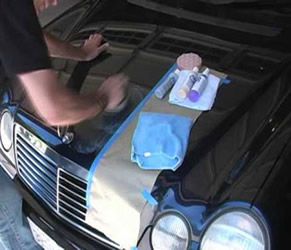 All
scratches are most visible at a 90 degree viewing angle, so a circular swirl is
visible from any vantage point. A linear type scratch is only noticeable from
a very narrow viewing angle. Work the glaze/polish into the surface using moderate
pressure until all that is left is a slight haze. (Read the directions on the
bottle to determine the manufacturer's recommended method.) Buff out the slight
haze with a soft 100% cotton cloth.
All
scratches are most visible at a 90 degree viewing angle, so a circular swirl is
visible from any vantage point. A linear type scratch is only noticeable from
a very narrow viewing angle. Work the glaze/polish into the surface using moderate
pressure until all that is left is a slight haze. (Read the directions on the
bottle to determine the manufacturer's recommended method.) Buff out the slight
haze with a soft 100% cotton cloth. 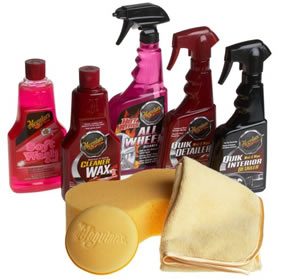 MEGUIAR
#01 MEDIUM CUT CLEANER: A moderately abrasive cleaner to remove surface defects
including harsh swirl marks, oxidation, water marks, and wet sanding marks. Follow
with a fine glaze (3M or #7) and a coat of wax. This is the "medium sandpaper
" of the abrasive cleaner set, so use only if your regular glaze will not
do the job.
MEGUIAR
#01 MEDIUM CUT CLEANER: A moderately abrasive cleaner to remove surface defects
including harsh swirl marks, oxidation, water marks, and wet sanding marks. Follow
with a fine glaze (3M or #7) and a coat of wax. This is the "medium sandpaper
" of the abrasive cleaner set, so use only if your regular glaze will not
do the job.